
【State】The Formal Emergence of the FireMatch Empire Game Development Concept
Document ID & Time Reference
Section titled “Document ID & Time Reference”Document ID: FM-DEV-0001
Establishment Time: 2025-11-15 【PST】
Publication Time: 2026-01-11 10:43 【PST】
Official Announcement
Section titled “Official Announcement”This document is an official 【State】 record within the FireMatch development progress archives.
Its purpose is to confirm a single fact:
FireMatch Empire, as a complete and long-term game development project,
had its core development concept formally emerge at this point in time,
and was recognized as something that required continuous construction.
State Description
Section titled “State Description”On 2025-11-15 【PST】, FireMatch internally reached its first explicit confirmation that:
- FireMatch Civilization would be treated as an independent game world and civilization simulation subject
- Related ideas were extracted from scattered inspirations and loose conceptual sketches
- The project would be regarded as an object requiring systematic thinking, long-term construction, and ongoing validation
This moment marks the transition of the project:
- From “the appearance of an idea”
- To “being formally acknowledged as a development object”
State Boundary Clarification
Section titled “State Boundary Clarification”This announcement does not represent:
- That any specific gameplay had been established
- That any system structures had been completed
- That any technical solutions had been finalized
- That any version, release timing, or commercial decisions had been made
This announcement exists solely to record that:
FireMatch Empire, as a development object,
formally began to exist at this point in time.
State Attributes
Section titled “State Attributes”- Type: 【State】
- Nature: Origin state confirmation
- Overwritable: No
- Constitutes a commitment: No
Historical Positioning
Section titled “Historical Positioning”As the starting record of the FM-DEV series,
this announcement serves as a temporal anchor for all subsequent development progress records.
All later records concerning concepts, systems, structures, and phases
are established on the premise that this state had already come into existence.
Appendix: Early Ideas and Initial Prototypes
Section titled “Appendix: Early Ideas and Initial Prototypes”Early Prototype Imagery
Section titled “Early Prototype Imagery”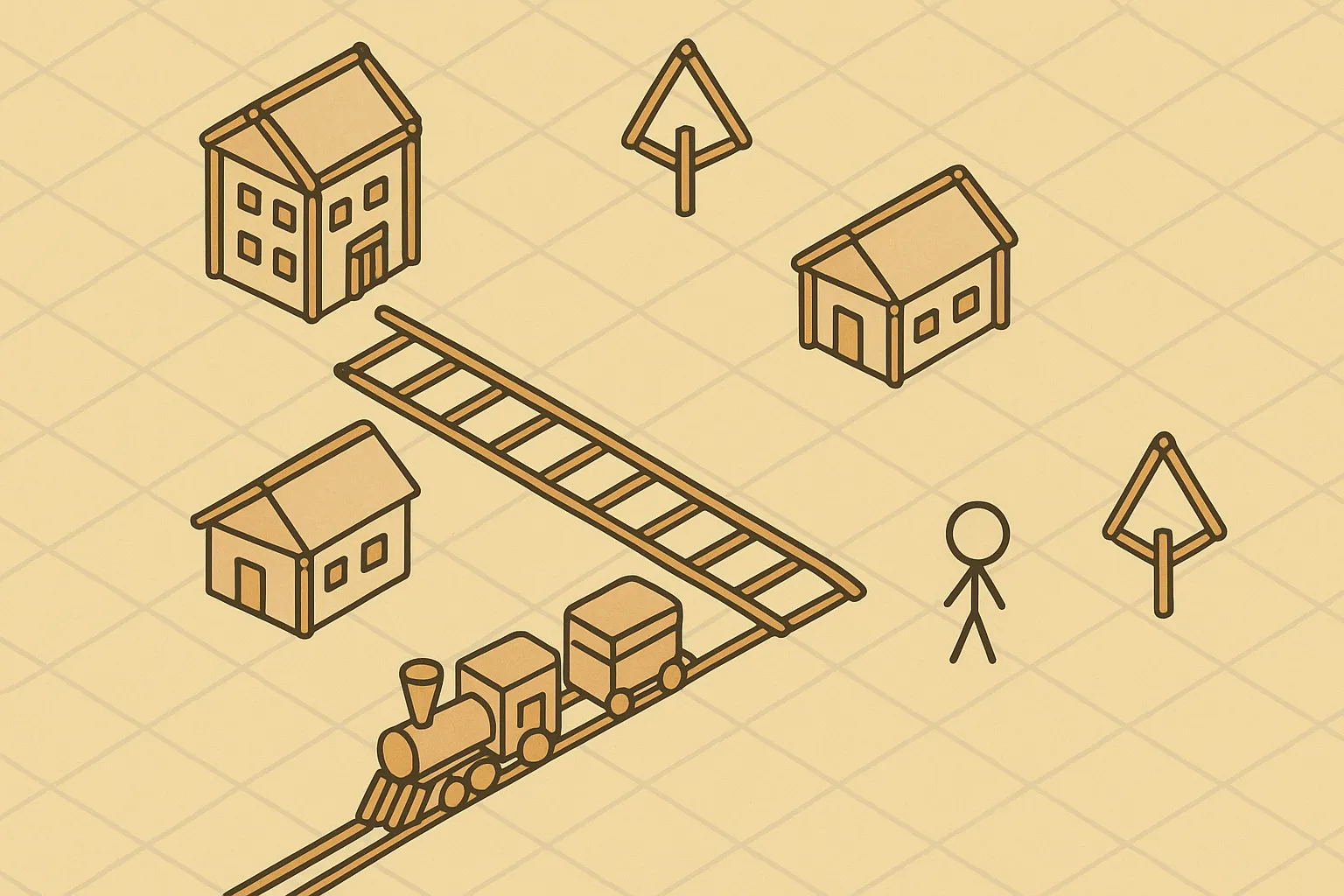
This image records an original prototype sketch from the conceptual germination stage of FireMatch Empire,
used to preserve the earliest ideas about the spatial layout, structure, and interaction of a “matchstick city.”
Early Prototypes and Initial Thinking
Section titled “Early Prototypes and Initial Thinking”The early prototype took the following form.
In the earliest conceptual stage of FireMatch Empire, the project did not begin with ideas of “civilization simulation” or “age progression.” Instead, it originated from a very intuitive—almost toy-like—question:
What would happen if an entire city were built out of matchsticks?
At that time, the core focus was not scale, complex systems, or long-term development, but physical presence. Everything was made of matchsticks—buildings, roads, trains, trees, and inhabitants. They appeared simple and fragile, yet undeniably coexisted within the same physical space.
The visuals adopted a minimal 2D isometric / top-down perspective. The map consisted of a regular grid, with each tile serving as a clearly defined construction unit. Players could place buildings, roads, or tracks within each tile. This perspective choice was not driven by aesthetics, but by a desire to make layout and structural relationships immediately legible.
At this stage, the world was treated as a physically coherent whole. Buildings were not abstract numerical entities, but structures composed of multiple matchsticks. In theory, they could collapse, be shaken, be ignited, and trigger chain reactions. Trains traveling along tracks were not merely transport tools, but sources of disturbance—the vibrations they caused could affect the structural stability of nearby buildings.
The initial gameplay loop was extremely direct:
- Players dismantled old buildings or gathered natural resources to obtain matchsticks, glue, and fuel.
- These resources were used to construct new buildings or repair damaged structures.
- Buildings provided only the most basic functions: housing, production, and minor happiness increases.
- Trains moved resources across the map and could also trigger accidental events.
Events were not scripted. Instead, they emerged naturally from physical and material properties. Ignited matchsticks could cause fires, fires could spread along structures, collapsing buildings could destabilize adjacent tiles, and multiple factors combined could cause sudden, dramatic changes to the city.
From a technical standpoint, there was even early consideration of using Godot’s 2D physics system, with each building composed of multiple rigid bodies and joints, simulating real collapses and vibrations. This idea later proved unfeasible at scale, but its influence persisted: the city was no longer seen as a “static board,” but as a system perpetually at risk of imbalance.
The initial scenario was deliberately small:
A 5×5 grid,
a single small residential building,
one road segment, and a short stretch of railway.
Players could directly drag matchsticks to build, watch trains move along the tracks, observe buildings shake or collapse due to vibrations, recover resources from ruins, and continue experimenting.
Victory and failure conditions were equally simple:
- Successfully establishing the most basic city structure and connecting the railway constituted victory.
- If all buildings collapsed or the railway was severed, the game ended in failure.
At that time, this prototype carried no concepts of “civilization,” “history,” or “ages.” It was closer to an experimental sandbox exploring structure, fragility, and chain reactions. Through these experiments, however, we gradually realized that the truly valuable question was not whether matchsticks would fall—but how a system composed of simple units could, over long-term operation, form its own order.
This realization ultimately propelled FireMatch Empire away from a “physical toy city,”
and toward a civilization evolution simulation.
— FireMatch Studio